Proposal for developmental researchers #10

Replies: 7 comments 33 replies

-
|
Hi Makoto Have you seen the detailed investigation here: Wilkinson, C. L., Yankowitz, L. D., Chao, J. Y., Gutiérrez, R., Rhoades, J. L., Shinnar, S., ... & Nelson, C. A. (2024). Developmental trajectories of EEG aperiodic and periodic components in children 2–44 months of age. Nature communications, 15(1), 5788.? They report a significant increase in aperiodic slope in the first year of life, in contrast with the often reported age related flattening following that. In our own samples of 3K adolescents/adult RS EEGs, we also reproduce age-related decreases in slope, as well as the interaction with sex reported here (which may be relevant due to its relation to overall brain size?) |
Beta Was this translation helpful? Give feedback.

-
|
Yes, and interestingly, they disagree: Aperiodic offset and slope significantly increased with age (FDR-adjusted q values < 0.001), and age-by-sex interactions were present for both aperiodic offset (F = 5.28, q = 0.002) and slope (F = 3.04, q = 0.03). Modeled developmental trajectories of the aperiodic offset showed a qualitatively sharp linear increase over the first year after birth for both males and females (Fig. 1h) <-> The aperiodic exponent shows a strong decrease in the first half year of life. |
Beta Was this translation helpful? Give feedback.

-
|
Thank you for pointing this out, @KrisBaetens! I didn't know about Wilkinson et al., and you’ve just provided a good reason to dive into it. Thank you! |
Beta Was this translation helpful? Give feedback.

-
|
Hi @KrisBaetens and @dieloz, Thank you for the info! Sorry for my belated response. I think age-related decrease in 1/f^alpha slope agrees the direction of change in terms of my myelination model: unmyelinated axons are same as dendrites and show more low-pass filter. Therefore, a brain with myelinated axons should show flatter PSD than a brain with unmyelinated axons. I wonder what interpretations these papers made. If there is a way to run a correlation between a ratio of myelinated vs. unmyelinated axons over alpha in 1/f^alpha, it would directly verify the myelination hypothesis. By the way, the Wilkinson paper says they used ICA? Rejecting ICs increases gamma-band power. See this Wiki article. |
Beta Was this translation helpful? Give feedback.
-
|
It would seem unlikely to me for myelinisation to be the whole story. I have 1300+ resting EEGs of participants age 30-80, and in this sample, too, slope significantly decreases over time (more so for females than males). Per my knowledge, the large developmental myelinisation should be sort of over by then? That said, in the subsample of about 800 patients in the age range 15-30, the slope decrement is for sure steeper (and no interaction with sex assigned at birth). This is patient data, though, and so generalisability is restricted. |
Beta Was this translation helpful? Give feedback.

-
|
Thanks @dieloz for plugging our paper! 🙂 I found this discussion through that mention. I just wanted to briefly say that the discrepancy between my paper and the Wilkinson one is because the Wilkinson paper fits a different model to the spectrum, it's changed to deal with their high beta peak. Mine is the very standard specparam one. Why this entirely flips the direction of the age-effect is still not clear too me... |
Beta Was this translation helpful? Give feedback.

-
|
My preliminary results on babies from ~200 to ~800 days. Just basic correlations. If that helps to the discussion. Slope changes drastically with age, the offset not at all. Some development literature: https://doi.org/10.1111/psyp.14360 |

Beta Was this translation helpful? Give feedback.
-
|
Hi @amisepa and @Contrerana, Cedric, I would imagine that the cable theory is the main source of the low-pass filter effect (i.e., so-called 'dendritic filter' and unmyelinated axons), if I read EFB correctly. Again, this is one of the two factors of the low-pass filter effect explained in EFB. AMPA-R/GABA_A-R thing can change the balance significantly, I admit, and I do not know how dominant it is compared with the cable-theory LPF. Anyway, these two are established theoretically and empirically compared with other factors you listed--that is my view. I say this because if you list up all qualitatively plausible factors, it does not go anywhere. We only trust successful pairs of theoretical predictions and empirical observations. |
Beta Was this translation helpful? Give feedback.

-
|
@MakotoMiyakoshi sounds good. This is a discussion, so I'm discussing possibilities. But yeah, at some point we need to make clear predictions and test them. This sounds great. Not sure I have time for the literature review. But from a quick search look what I found: 
"a, A schematic graph of forebrain myelin changes during the human life span, summarizing data interpreted from early histological9,10,11,12,13,14,35, modern MRI5,6 and gene expression15 studies, with a slight focus on cortical myelin changes. The shaded areas correspond to the myelin waves, that is, periods of rapid synchronized myelin change during early years, adolescence and aging, and the numbers above indicate the different stages of myelination as defined by Flechsig, Yakovlev and Lecours, and others. b, Schematic of the different cycles of myelination defined as the length of time from onset of myelination of a tract/area to its completion: (1) monophasic (clear fast onset and completion of myelination), for example, optic nerve or auditory brain stem; (2) multiphasic (onset followed by a pause before a separate myelination round), for example, cingulum, uncinate fasciculus and parahippocampal gyrus; or (3) slow continuous/protracted myelination cycle, for example, commissural and association fibers. Horizontal bars exemplify rounds of myelination across time that are characteristic for each cycle14. The third bar on the multiphasic cycle is faded to convey that the exact number of cycles is specific to each tract/area. Note that the timing of onset and completion of a myelination cycle can be highly variable and tract dependent. |
Beta Was this translation helpful? Give feedback.
-
|
I think the correlation analysis is a great idea, nice and simple. We just need to find some datasets that over the full age range. I'd be happy to run the analysis |
Beta Was this translation helpful? Give feedback.
-
|
I'll put this AMPA/GAPA ratio over age here so I don't forget: https://www.nature.com/articles/s41598-020-68165-1/figures/6 They calculated the tE/I ratio as: the sum of AMPA receptor subunit mRNA expression divided by tge sum of GABA_A receptor subunit mRNA expression. So this is a gene expression-based ratio. |

Beta Was this translation helpful? Give feedback.
-
|
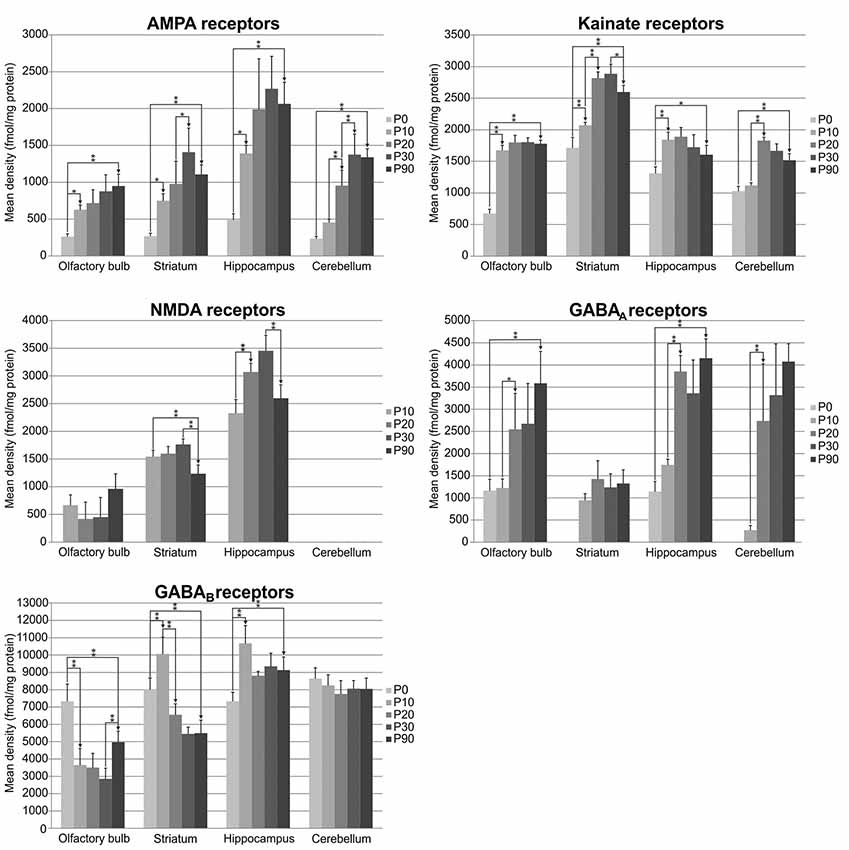
And this rat study: https://www.frontiersin.org/files/Articles/485287/fnana-13-00100-HTML/image_m/fnana-13-00100-g002.jpg 
In developing Wistar rats from birth to adulthood (P0-P90), AMPA receptors increased 262-471% across all brain regions examined (with the largest increase in cerebellum at 471%), while GABA_A receptors showed even more dramatic developmental increases that were heavily concentrated in a critical window from P10 to P20 when the most significant density changes occurred (coinciding with the functional shift of GABA from excitatory to inhibitory transmission), reaching their highest absolute values at P90, meaning the AMPA/GABA_A ratio would initially be relatively high at birth when both receptor types are present but low in absolute density, then shift dramatically toward inhibition during P10-P20 when GABA_A receptors undergo their most explosive growth (especially the 907% increase in cerebellum), and subsequently stabilize into adulthood with ongoing gradual increases in both systems but with GABA_A receptors maintaining higher absolute expression levels by P90, suggesting that the establishment of the mature E/I balance in rats is driven primarily by the massive upregulation of inhibitory GABA_A receptors during the second and third postnatal weeks rather than by changes in excitatory AMPA receptor expression |
Beta Was this translation helpful? Give feedback.
-
|
Interesting stuff, thanks for sharing! The matter of spatial distribution would also potentially emerge as relevant from this - something I haven't seen very extensively tackled. |
Beta Was this translation helpful? Give feedback.

-
|
I agree wih you that is not properly studied but it makes sense to me as for instance myelination process is also asymetric, from posterior to anterior if I am not wrong. Some structural and functional connectivity analysis also reporting a later peak on the frontal areas with age. All of it should be related somehow. |
Beta Was this translation helpful? Give feedback.

-
|
If anyone has access to brain organoid models, that could be very helpful to study the effects of myelination on a periodic component and other aspects of developing brain. |
Beta Was this translation helpful? Give feedback.
-
|
I wonder if this discussion is a link towards the conversation we had with Mate by email around heartbeat-evoked potentials and the potential role of cardiovascular mechanisms. |
Beta Was this translation helpful? Give feedback.

-
Yes, this test can be potentially dangerous. Therefore, it is stopped immediately after the appearance of delta activity, preventing irreversible changes. Long-term recordings were performed in questionable cases where no significant slow activity was observed, and the reduced blood flow was only evident as a decrease in the average EEG frequency. |
Beta Was this translation helpful? Give feedback.
-
Unfortunately, I see another possible explanation for the observed effect: perhaps the influence of an artifact, namely muscle activity. The test is uncomfortable for the patient, they may tense up, and the myographic signal will interfere with the EEG, with the relative increase being greater for higher frequencies, which could simulate a decrease in the slope. How to eliminate this artifact is unclear to me. So, the data is still highly questionable. |
Beta Was this translation helpful? Give feedback.
-
Oh yes, agreed absolutely. See this paper by Whitham et al. (2007). In B, "Topical pharyngeal lignocaine was used to provide anaesthesia in preparation for insertion of a laryngo-pharyngeal mask airway. The paralysant was cisatracurium, 20 mg given by intravenous injection." 
|
Beta Was this translation helpful? Give feedback.
-
|
@EugenMasherov Before we created the Github discussions, @mgy42 and I discussed the potential role of the heart in modulating/participating/generating part of the aperiodic component. See for example: https://elifesciences.org/reviewed-preprints/100605 |
Beta Was this translation helpful? Give feedback.

-
|
I tried to find a way to remove the cardiographic artifact from the EEG.
It's partially eliminated by regression on the ECG signal (which perhaps
proves that it's simply numbness in the neck, like a "fifth limb"), but
there was a component, up to 30% of the power, that couldn't be eliminated,
and when attempting to localize it, it was located at the base of the
brain. Perhaps this is simply a reflection of conductivity inhomogeneities,
but it could also be potentials arising in the brainstem, associated with
the regulation of cardiac activity.
пт, 6 февр. 2026 г. в 06:16, Cedric Cannard ***@***.***>:
… I wonder if this discussion is a link towards the conversation we had with
Mate by email around heartbeat-evoked potentials and the potential role of
cardiovascular mechanisms.
—
Reply to this email directly, view it on GitHub
<#10 (reply in thread)>,
or unsubscribe
<https://github.com/notifications/unsubscribe-auth/B2DLTZHEA5A2E4VWGBELOW34KQBPFAVCNFSM6AAAAACNDCBNK6VHI2DSMVQWIX3LMV43URDJONRXK43TNFXW4Q3PNVWWK3TUHMYTKNZRGM4DMNY>
.
You are receiving this because you were mentioned.Message ID:
***@***.***>
|
Beta Was this translation helpful? Give feedback.
-
|
Stefan Debener conducted a series of studies between mid 2000's-early 2010's on ballistocardiogram artifact in fMRI-EEG. It may not be exactly what you obsereve since in his case there was strong stationary magnetic field. But he reported that ICA-decomposed 'sources' of those BCG artifacts are typically in the center of the brain near the neck. |
Beta Was this translation helpful? Give feedback.
-
|
@EugenMasherov you can try my toolbox BrainBeats (using ICA): https://github.com/amisepa/BrainBeats |
Beta Was this translation helpful? Give feedback.
-
|
A long-standing attempt to assess the influence of cardiac cycle phase on
the alpha rhythm. The horizontal axis is the percentage of the RR interval
duration.
The instantaneous frequency and amplitude of the envelope were calculated
using the Hilbert transform after narrow-band filtering.
Then, the frequency and amplitude values were averaged for each sample as a
percentage.
Unfortunately, this didn't generate any interest; it was limited to one
study.
However, the question is how to assess the influence of cardiac cycle phase
on the spectrum slope, given that it's unlikely that the spectrum can be
assessed over the course of a cycle (maximum 1-2 oscillations in the delta
rhythm region; at higher frequencies, it's better, but not much). This
seems like a challenge, but I don't yet know how to answer it.
[image: FreqAlpha.jpg]
Frequency change (Hz)
[image: AmpAlpha.jpg]
Amplitude change (nanovolts)
вт, 10 февр. 2026 г. в 23:59, Cedric Cannard ***@***.***>:
… @EugenMasherov <https://github.com/EugenMasherov> Before we created the
Github discussions, @mgy42 <https://github.com/mgy42> and I discussed the
potential role of the heart in modulating/participating/generating part of
the aperiodic component. See for example:
https://elifesciences.org/reviewed-preprints/100605
https://www.nature.com/articles/s41467-023-40250-9
I'll start a discussion for that in case we want to explore this further
with a proper analysis
—
Reply to this email directly, view it on GitHub
<#10 (reply in thread)>,
or unsubscribe
<https://github.com/notifications/unsubscribe-auth/B2DLTZFPHI7QR5NMRLXFEAL4LJBD3AVCNFSM6AAAAACNDCBNK6VHI2DSMVQWIX3LMV43URDJONRXK43TNFXW4Q3PNVWWK3TUHMYTKNZWGEZTGOA>
.
You are receiving this because you were mentioned.Message ID:
***@***.***>
|
Beta Was this translation helpful? Give feedback.
-
|
@EugenMasherov I don't think the images went through. Can you please move everything related to heart in this discussion: #14 And it sounds like you may be describing basically heartbeat-evoked potentials (HEP; time domain) or Heartbeat-evoked oscillations in frequency domain (HEO; also called sometimes Heartbeat-related spectral perturbation)? |
Beta Was this translation helpful? Give feedback.
-
|
Thanks Cedric for traffic control. |
Beta Was this translation helpful? Give feedback.
-
|
Moved to the appropriate thread. The images aren't clear; they're visible on some computers, but not on others. It might be a browser difference; please check. |
Beta Was this translation helpful? Give feedback.
-
|
A possible algorithm: pass the signal through a comb of narrow-band
filters, calculate the instantaneous amplitude for each component (possibly
using a Hilbert transform), then split the intervals R-R into N parts and
calculate the amplitude for each frequency and for each position within the
interval. Averaging over all intervals yields a spectrum as a function of
the position within the interval.
ср, 11 февр. 2026 г. в 16:21, Евгений Машеров ***@***.***>:
… A long-standing attempt to assess the influence of cardiac cycle phase on
the alpha rhythm. The horizontal axis is the percentage of the RR interval
duration.
The instantaneous frequency and amplitude of the envelope were calculated
using the Hilbert transform after narrow-band filtering.
Then, the frequency and amplitude values were averaged for each sample as
a percentage.
Unfortunately, this didn't generate any interest; it was limited to one
study.
However, the question is how to assess the influence of cardiac cycle
phase on the spectrum slope, given that it's unlikely that the spectrum can
be assessed over the course of a cycle (maximum 1-2 oscillations in the
delta rhythm region; at higher frequencies, it's better, but not much).
This seems like a challenge, but I don't yet know how to answer it.
[image: FreqAlpha.jpg]
Frequency change (Hz)
[image: AmpAlpha.jpg]
Amplitude change (nanovolts)
вт, 10 февр. 2026 г. в 23:59, Cedric Cannard ***@***.***>:
> @EugenMasherov <https://github.com/EugenMasherov> Before we created the
> Github discussions, @mgy42 <https://github.com/mgy42> and I discussed
> the potential role of the heart in modulating/participating/generating part
> of the aperiodic component. See for example:
> https://elifesciences.org/reviewed-preprints/100605
> https://www.nature.com/articles/s41467-023-40250-9
> I'll start a discussion for that in case we want to explore this further
> with a proper analysis
>
> —
> Reply to this email directly, view it on GitHub
> <#10 (reply in thread)>,
> or unsubscribe
> <https://github.com/notifications/unsubscribe-auth/B2DLTZFPHI7QR5NMRLXFEAL4LJBD3AVCNFSM6AAAAACNDCBNK6VHI2DSMVQWIX3LMV43URDJONRXK43TNFXW4Q3PNVWWK3TUHMYTKNZWGEZTGOA>
> .
> You are receiving this because you were mentioned.Message ID:
> ***@***.***>
>
|
Beta Was this translation helpful? Give feedback.


Uh oh!
There was an error while loading. Please reload this page.
-
I predict that children show generally steeper slopes in EEG 1/f-ness than adults because unmyelinated axons are analogous to dendrites to which cable theory applies (other thing being equal, of course).
Do any of you have resting-state EEG data recorded from children? Actually I do--I am working at children's hospital.
Do any of you want to test this hypothesis?
Beta Was this translation helpful? Give feedback.
All reactions