This project is worked with Chris Norrie(b19chrno@his.student.se)
It presents a real-time emotion classification framework resulting in a dashboard providing important analytics regarding the public opinion (for specific topics)
The main idea is to build an emotion-detection framework that in real-time streams every tweet with a specific hashtag (in our case #Covid19). First information such as the location of the user is extracted. Then tweets are classified as either happy, angry, sad, or scared
The acquired information is loaded through elasticsearch into a Kibana's Dashboard visualizing the results An example of its usage is given below:
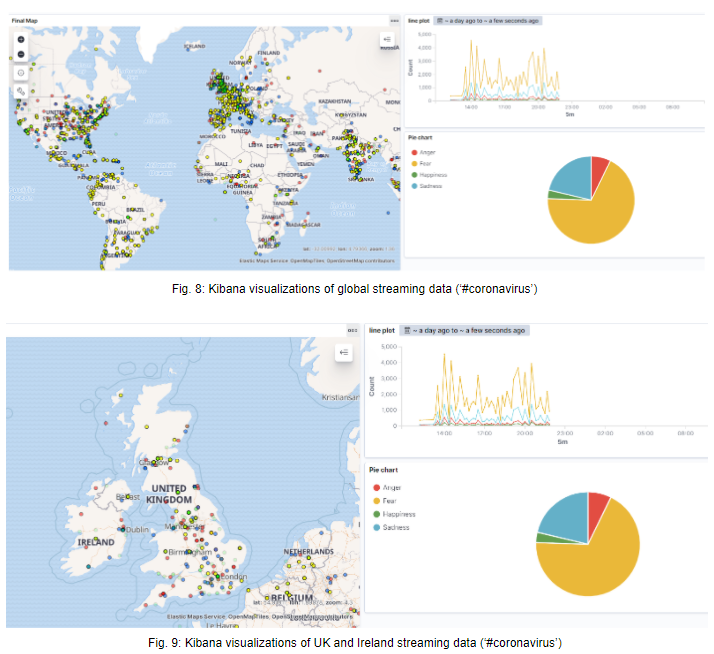
The project is split into several steps:
Step1: Acquire a training data set A good classifier requires an adequate and balanced training sample. In our case, we look for a balanced number of happy, sad, angry, and scared tweets. Manually annotating thousands of tweets is not possible.
As a result, we focus on the hashtags to mine the desired tweets. For example, a tweet ending in: #happy, #thrilled #happiness is probably a happy tweet.
Following this approach and a specific set of designed heuristics (to make sure the extracted tweets carry the desire emotion) we construct our training dataset.
Step2: Pre-process Tweets
Tweeter language is much different from academic articles or well-written reports. Different vocabulary, slang, and emojis are some of the most important issues. We apply extensive pre-process of each tweet before training our learning algorithm For details refer to either the report or the presentation
Step3: Pick & Train a Machine Learning Model
Next, we train several neural networks before making our selection. Several variations of LSTMs are trained as classifiers and a performance investigation is performed before making our selection
Step4: Design the Pipeline and the Framework
Once training is complete we build our pipeline "listening" to tweets with a specific hashtag, preprocessing them and classifying them, before loading them to Kibana.