Application: Purchasing Description: Internal Requisitions/Deliveries Discrepancy Report Source: Internal Requisitions/Deliveries Discrepancy Report (XML) Short Name: POXRQSDD_XML
Operating Unit, Requisition Number From, Requisition Number To, Requester, Requisition Date From, Requisition Date To, Destination Organization, Sort By
po_requisition_headers, po_requisition_lines, mtl_system_items_vl, per_all_people_f, org_organization_definitions, po_system_parameters, hr_operating_units, mtl_parameters, oe_order_lines_all, oe_order_headers_all
If you would like to try one of these Oracle EBS SQLs without having Blitz Report installed, note that some of the reports require functions from utility package xxen_util.
PO Internal Requisitions Deliveries Discrepancy 09-Apr-2018 101808.xlsx
www.enginatics.com/reports/po-internal-requisitions-deliveries-discrepancy/
Blitz Report™ import options
PO_Internal_Requisitions_Deliveries_Discrepancy.xml
The PO Internal Requisitions-Deliveries Discrepancy report is a critical internal supply chain reconciliation tool within Oracle E-Business Suite. It is specifically designed to highlight mismatches between internal requisitions (demand from one internal organization) and the actual delivery of goods against the corresponding internal sales orders. This report is indispensable for procurement, inventory, and order management teams to identify and investigate operational breakdowns, resolve discrepancies, and ensure the efficient and accurate flow of materials between internal entities, thereby optimizing the internal supply chain.
Efficient internal material transfers are vital for manufacturing continuity and inter-departmental service levels. However, discrepancies between what was requested and what was delivered internally are common and can lead to significant operational issues:
- Lack of Reconciliation: It is often challenging to reconcile the quantity or items requested on an internal requisition with what was actually shipped and received against the internal sales order. This lack of visibility can lead to material shortages or overstocks.
- Operational Bottlenecks: Discrepancies often indicate a breakdown in the internal transfer process, such as partial shipments, incorrect items being sent, or receiving errors. Identifying these specific issues is crucial for corrective action.
- Impact on Production and Projects: Delays or errors in internal deliveries directly impact production schedules, project timelines, and the availability of materials for various internal stakeholders.
- Manual Investigation: Without a specialized report, investigating these discrepancies requires time-consuming manual comparisons across multiple Oracle modules (Purchasing, Order Management, Inventory), leading to prolonged resolution times.
This report offers a powerful and focused solution for identifying and managing discrepancies in internal requisitions and deliveries, enhancing internal supply chain transparency.
- Highlights Discrepancies: The report specifically flags and details instances where there is a mismatch between the internal requisition details and the corresponding delivery/receipt information on the internal sales order, making anomalies immediately visible.
- Consolidated Data View: It brings together relevant information from internal requisitions, internal sales orders, and inventory receipt transactions into a single, comprehensive report, providing an end-to-end view of the internal transfer process.
- Accelerated Problem Resolution: By pinpointing the exact discrepancies (e.g., quantity variance, item mismatch), the report empowers procurement and inventory teams to quickly investigate the root cause and implement corrective actions.
- Improved Internal Customer Service: Proactively addressing discrepancies ensures that internal customers receive their requested materials accurately and on time, improving satisfaction and operational flow.
The report queries core Oracle Purchasing, Order Management, and Inventory tables, specifically designed to identify discrepancies between the internal requisition and sales order fulfillment.
- Primary Tables Involved:
po_requisition_headersandpo_requisition_lines(for internal requisition details).oe_order_headers_allandoe_order_lines_all(for corresponding internal sales order details).mtl_system_items_vl(for item master details).per_all_people_f(for requester information).org_organization_definitionsandhr_operating_units(for organizational context).rcv_transactions(for actual receipt data against internal sales orders).
- Logical Relationships: The report establishes a link between
po_requisition_linesandoe_order_lines_all(as internal sales orders are generated from internal requisitions). It then compares the requested quantities on the requisition line with the quantities shipped/received against the sales order, utilizingrcv_transactionsfor delivery details, to highlight any variances or mismatches.
The report offers flexible parameters for targeted analysis of internal requisition and delivery discrepancies:
- Organizational Context:
Operating UnitandDestination Organizationallow for filtering by specific business units and the receiving inventory organization. - Requisition Identification:
Requisition Number From/ToandRequesterenable focusing on specific internal demand requests or those from particular individuals. - Date Ranges:
Requisition Date From/Toallows for analyzing discrepancies that occurred within specific periods. - Sort By: Provides flexibility in organizing the report output for easier analysis (e.g., by Requisition Number, Item, or Discrepancy Type).
As a transactional reconciliation report integrating data across multiple modules, it is optimized through strong filtering and efficient joining strategies.
- Parameter-Driven Efficiency: The use of specific
Requisition Numberranges andRequisition Dateranges is critical for performance, allowing the database to efficiently narrow down the large transactional datasets to relevant internal orders. - Targeted Discrepancy Logic: The report's SQL is specifically designed to perform comparisons and identify variances efficiently, avoiding full table scans of all requisition and sales order lines unless necessary.
- Indexed Lookups: Queries leverage standard Oracle indexes on
requisition_header_id,requisition_line_id,order_header_id,order_line_id, anditem_idfor efficient data retrieval across Purchasing, Order Management, and Inventory tables.
1. What types of discrepancies does this report typically identify? This report commonly identifies quantity discrepancies (e.g., requested 10, delivered 8), item mismatches (e.g., wrong item sent), or open requisitions for which no corresponding delivery has been recorded. It helps pinpoint situations where the internal supply chain has not fully met the internal demand.
2. How should an organization resolve discrepancies found in this report? Resolution depends on the nature of the discrepancy. It might involve: coordinating with the shipping/receiving organizations to correct receipt quantities, processing returns for incorrect items, or expediting outstanding internal sales orders. The detailed information in the report provides the starting point for investigation.
3. Can this report also show pricing discrepancies between the requisition and the sales order?
While the report focuses on quantities and items, it could potentially be extended to compare pricing (e.g., internal transfer price vs. requisition estimated price) if the relevant pricing attributes are stored and can be joined from the oe_order_lines_all and po_requisition_lines_all tables.
Oracle E-Business Suite Reporting Library
We provide an open source Oracle EBS SQLs as a part of operational and project implementation support toolkits for rapid Excel reports generation.
Blitz Report™ is based on Oracle EBS forms technology, and hence requires minimal training. There are no data or performance limitations since the output files are created directly from the database without going through intermediate file formats such as XML.
Blitz Report can be used as BI Publisher and Oracle Discoverer replacement tool. Standard Oracle BI Publisher and Discoverer reports can also be imported into Blitz Report for immediate output to Excel. Typically, reports can be created and version tracked within hours instead of days. The concurrent request output automatically opens upon completion without the need for re-formatting.
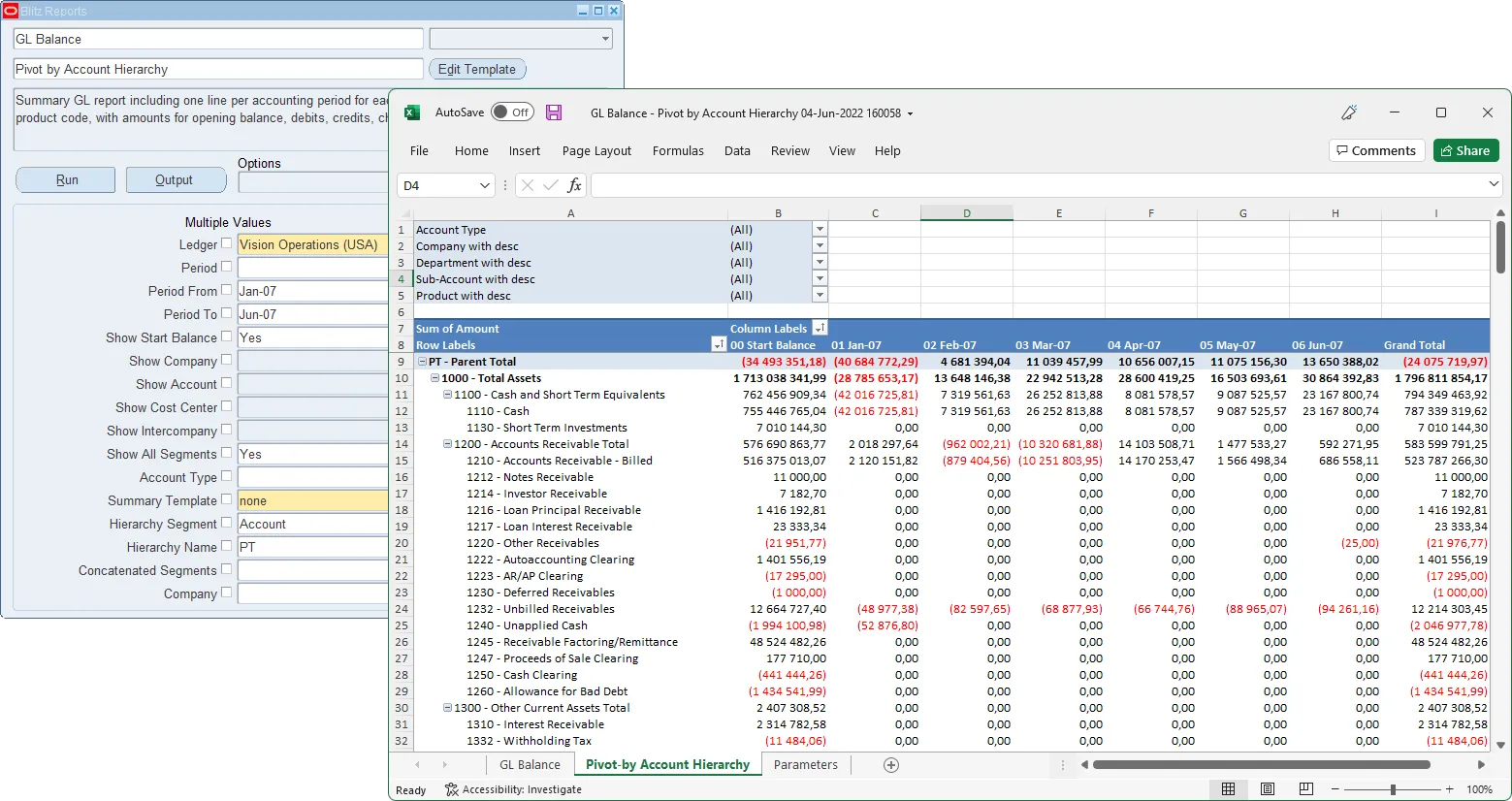
The Filters, Columns, Rows and Values fields are used to create and deliver the data in pivot table format with full drill down to details.
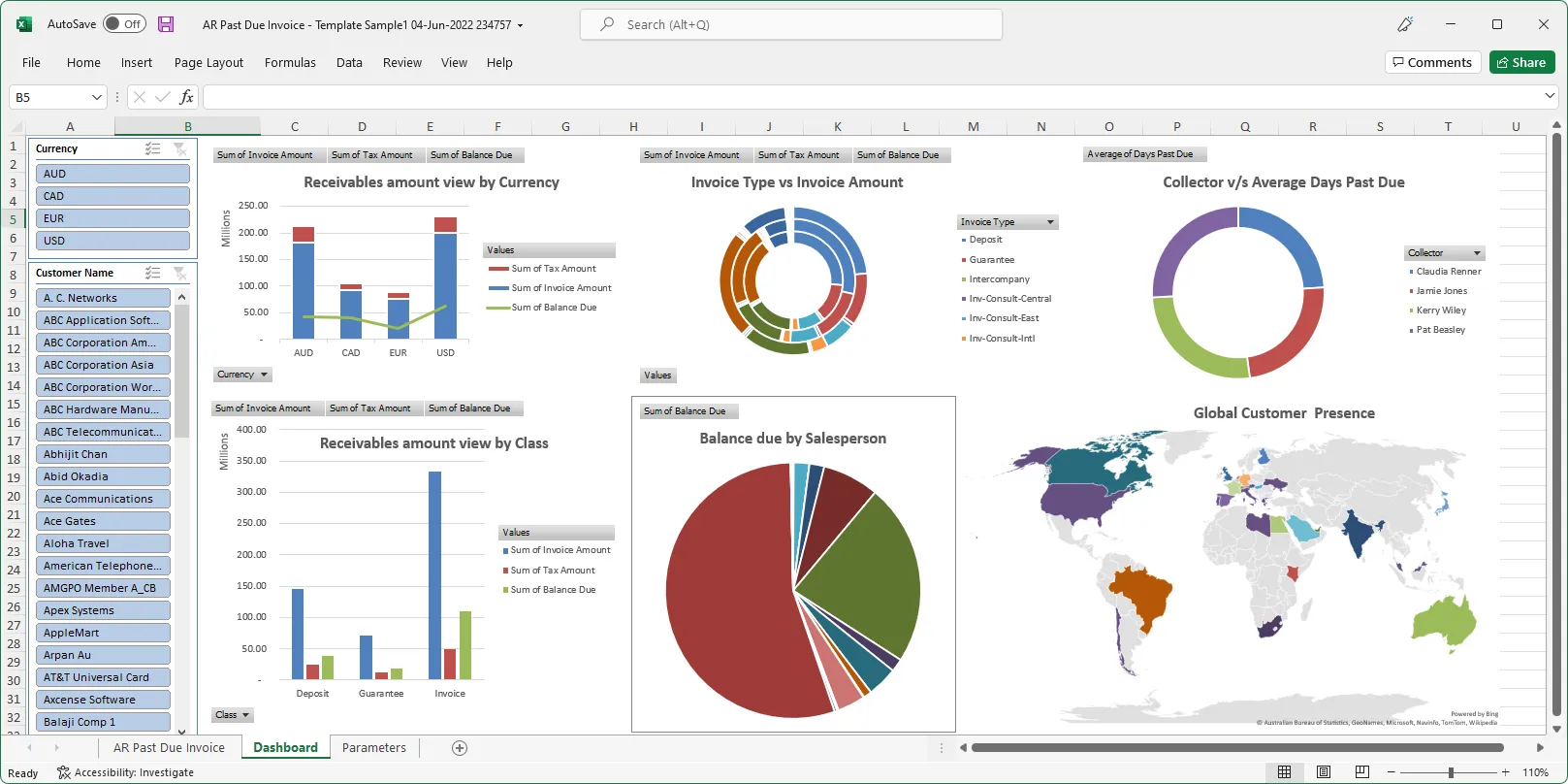
The Excel template upload functionality in Blitz Report allows users to create their own layouts by uploading an Excel template with additional sheets and charts, automatically refreshed when the report runs again. This allows to create custom dashboards and more advanced visualizations of report data.
You can download and use Blitz Report free of charge for your first 30 reports.
The installation and implementation process usually takes less than 1 hour; you can refer to our installation and user guides for specific details.
If you would like to optimize your Oracle EBS implementation and or operational reporting you can visit www.enginatics.com to review great ideas and example usage in blog. Or why not try for yourself in our demo environment.
Blitz Report™ – World’s fastest data upload and reporting for Oracle EBS
Oracle Discoverer replacement – importing worksheets into Blitz Report™
Blitz Report™ Questions & Answers
Supply Chain Hub by Blitz Report™
© 2025 Enginatics