Imported from Concurrent Program Description: Budgetary Control Results Report Program Application: Public Sector Financials Source: Budgetary Control Results Report Short Name: PSABCRRP DB package: XXEN_PSA
The Expand Amounts Yes/No Parameter determines whether or not the Budget, Encumbrances, Expenditures, and Funds Available Amounts are displayed on the same excel row (Expand=No) or are split into separate excel rows (Expand=Yes) in the generated excel.
The following templates are provided with this report:
Corresponds to the standard Oracle Budgetary Control Status Report. Budget, Encumbrances, Expenditures, and Funds Available Amounts are displayed on separate rows in the generated Excel
Flat File one row per transaction extract. Budget, Encumbrances, Expenditures, and Funds Available Amounts are included as separate columns on the same excel row
Ledger Name, Period From, Period To, JE Batch Name, Account From, Account To, Funds Result Status, Order By, Expand Amounts
&lp_expand_tables, gl_ledgers, gl_code_combinations_kfv
CAC Intransit Value (Real-Time), CAC AP Accrual IR ISO Match Analysis
If you would like to try one of these Oracle EBS SQLs without having Blitz Report installed, note that some of the reports require functions from utility package xxen_util.
www.enginatics.com/reports/psa-budgetary-control-transactions/
Blitz Report™ import options
PSA_Budgetary_Control_Transactions.xml
The PSA Budgetary Control Transactions report is a critical financial control and audit tool designed for organizations utilizing Oracle Public Sector Financials, particularly for budgetary control. It provides a detailed view of transactions that have passed through budgetary control, showing the impact on budgets, encumbrances, expenditures, and funds available. This report is indispensable for finance managers, budget officers, and auditors to monitor spending against approved budgets, prevent over-expenditure, ensure compliance with government accounting regulations, and maintain fiscal accountability.
Managing public or grant funds requires stringent budgetary control to prevent overspending and ensure resources are allocated appropriately. Organizations often face significant challenges in achieving this:
- Preventing Overspending: Without real-time visibility into funds available and their consumption, it's easy for departments to inadvertently overspend their allocated budgets, leading to financial penalties or audit findings.
- Tracking Encumbrances: Accurately tracking outstanding commitments (encumbrances) against a budget is crucial for understanding true available funds, but this can be complex to report on effectively.
- Reconciliation and Audit: Reconciling actual expenditures and encumbrances with the budget for specific accounts or periods is a foundational requirement for public sector financial reporting and a major audit focus.
- Reporting Flexibility: Standard Oracle budgetary control reports may lack the flexibility to present data in different formats (e.g., flat file extract vs. pivot) or to filter precisely for specific budget transaction statuses or accounts.
This report offers a powerful, configurable, and auditable solution for budgetary control analysis, providing the transparency needed for responsible fund management.
- Real-time Funds Availability: It provides a clear picture of budget, encumbrances, expenditures, and available funds for each transaction or account, enabling proactive financial management and preventing overspending.
- Flexible Output Formats: The
Expand Amountsparameter is a key feature, allowing users to choose between a summarized view (amounts on one row) or a detailed view (amounts split into separate rows for pivot analysis), catering to different reporting needs. - Targeted Discrepancy Identification: By detailing the status of funds checks (
Funds Result Status), the report helps finance teams quickly identify transactions that failed budgetary control, allowing for prompt investigation and resolution. - Enhanced Compliance: The report provides robust documentation of budgetary control activity, which is essential for demonstrating fiscal accountability and compliance with public sector financial regulations.
The report queries core Oracle General Ledger and Public Sector Financials tables related to budgetary control.
- Primary Tables Involved:
gl_ledgers(for ledger context).gl_periods(for accounting period details).gl_code_combinations_kfv(for GL account segment details).- Underlying Public Sector Financials (PSA) tables for budgetary control (e.g.,
PSA_BC_XLA_ACCTS_V,PSA_BC_TRANSACTIONS) are likely involved to track the specific budgetary control impact of transactions. XXEN_PSA(the custom database package for this report) suggests custom logic for data extraction and formatting.
- Logical Relationships: The report links General Ledger accounts to their budgetary control activity. It retrieves budgetary balances, encumbrance amounts, and expenditure values, aggregating them by account and period. The
Funds Result Statusis derived from the budgetary control processing results, indicating whether a transaction passed or failed its funds check.
The report offers flexible parameters for targeted budgetary control analysis:
- Financial Context:
Ledger NameandOperating Unit(if applicable) define the financial and organizational scope. - Period Range:
Period FromandPeriod Toare critical for analyzing budgetary control activity over specific accounting periods. - Account Filters:
Account FromandAccount Toallow for precise targeting of specific GL accounts or ranges for analysis. - Status Filters:
Funds Result Statusallows users to focus on transactions that passed, failed, or were partially processed by budgetary control. - Output Format:
Expand Amounts(Yes/No) is a crucial parameter for controlling the report's layout for pivot table analysis or flat-file extraction. - Order By: Provides flexibility in sorting the report output.
As a financial report querying transactional and budgetary data, it is optimized by period and account-driven filtering.
- Period and Account-Driven Efficiency: The
Period From/ToandAccount From/Toparameters are crucial for performance, allowing the database to efficiently narrow down the large volume of GL and budgetary control data to the relevant timeframe and accounts using existing indexes. - Leveraging PSA Views (if applicable): Oracle Public Sector Financials often provides specialized views for budgetary control data, which can be optimized for performance. The
XXEN_PSApackage indicates custom optimization efforts. - Conditional Output Generation: The
Expand Amountsparameter allows the report to generate different output structures efficiently, avoiding unnecessary data manipulation when a simpler view is requested.
1. What is "Budgetary Control" and why is it important in Public Sector Financials? Budgetary Control is a set of rules and processes that prevent spending in excess of approved budget amounts. In public sector financials, it is critical for ensuring fiscal responsibility, compliance with legal budget limits, and preventing agencies or departments from overspending their allocated funds.
2. What does a "Funds Result Status" of 'Failed' indicate? A 'Failed' status indicates that a transaction (e.g., a purchase requisition, a journal entry) attempted to consume funds from a budget, but doing so would have caused the budget to be exceeded. The transaction was therefore rejected by the budgetary control system, preventing the overspending.
3. How does the Expand Amounts parameter change the report's usefulness?
When Expand Amounts is 'No', all budgetary figures (Budget, Encumbrance, Expenditure, Funds Available) appear as separate columns on a single row per account, ideal for a flat-file extract. When Expand Amounts is 'Yes', these amounts are typically broken into separate rows, which is perfect for building pivot tables in Excel to dynamically analyze and summarize budgetary data across different dimensions.
Oracle E-Business Suite Reporting Library
We provide an open source Oracle EBS SQLs as a part of operational and project implementation support toolkits for rapid Excel reports generation.
Blitz Report™ is based on Oracle EBS forms technology, and hence requires minimal training. There are no data or performance limitations since the output files are created directly from the database without going through intermediate file formats such as XML.
Blitz Report can be used as BI Publisher and Oracle Discoverer replacement tool. Standard Oracle BI Publisher and Discoverer reports can also be imported into Blitz Report for immediate output to Excel. Typically, reports can be created and version tracked within hours instead of days. The concurrent request output automatically opens upon completion without the need for re-formatting.
The Filters, Columns, Rows and Values fields are used to create and deliver the data in pivot table format with full drill down to details.
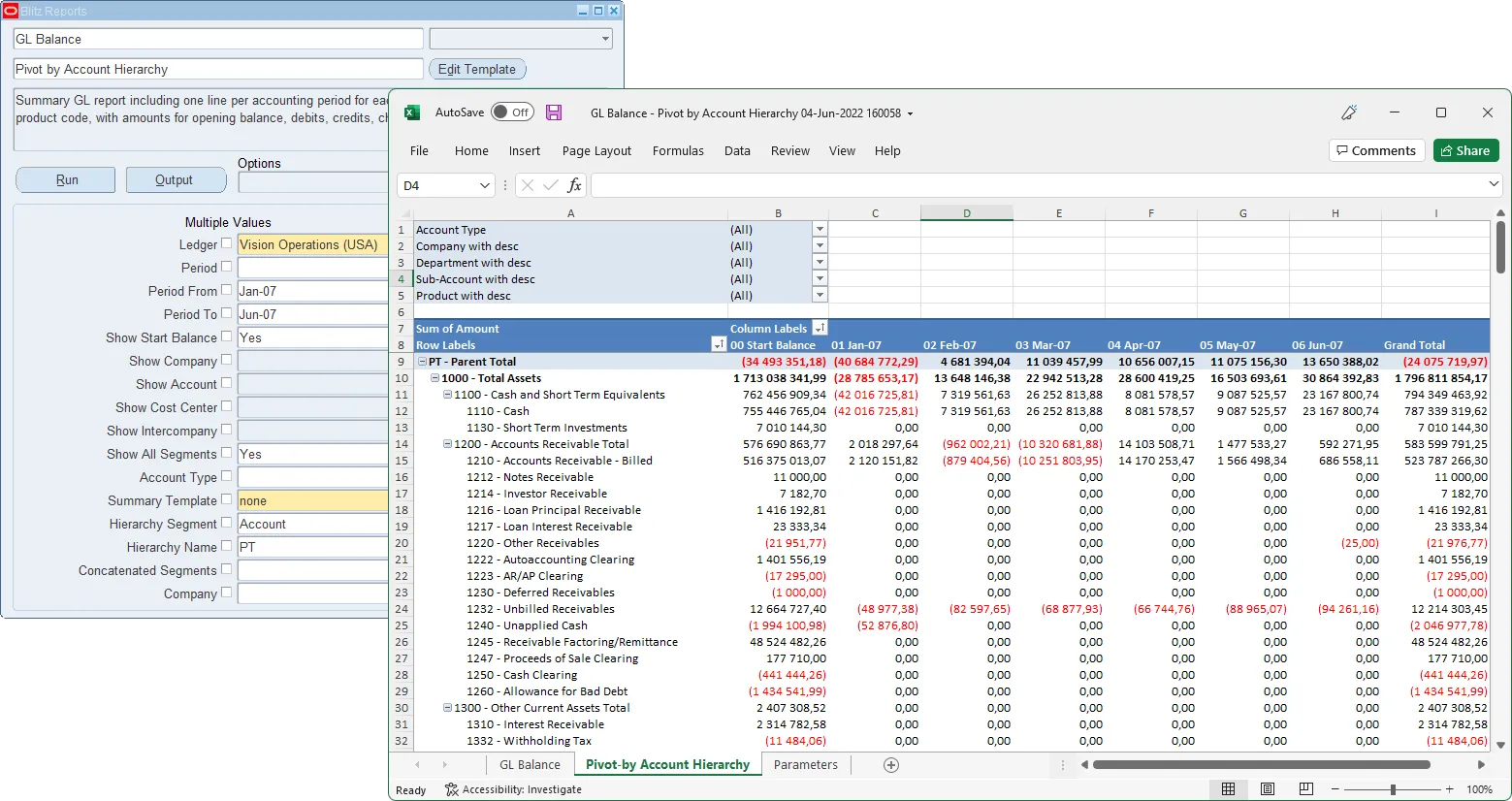
The Excel template upload functionality in Blitz Report allows users to create their own layouts by uploading an Excel template with additional sheets and charts, automatically refreshed when the report runs again. This allows to create custom dashboards and more advanced visualizations of report data.
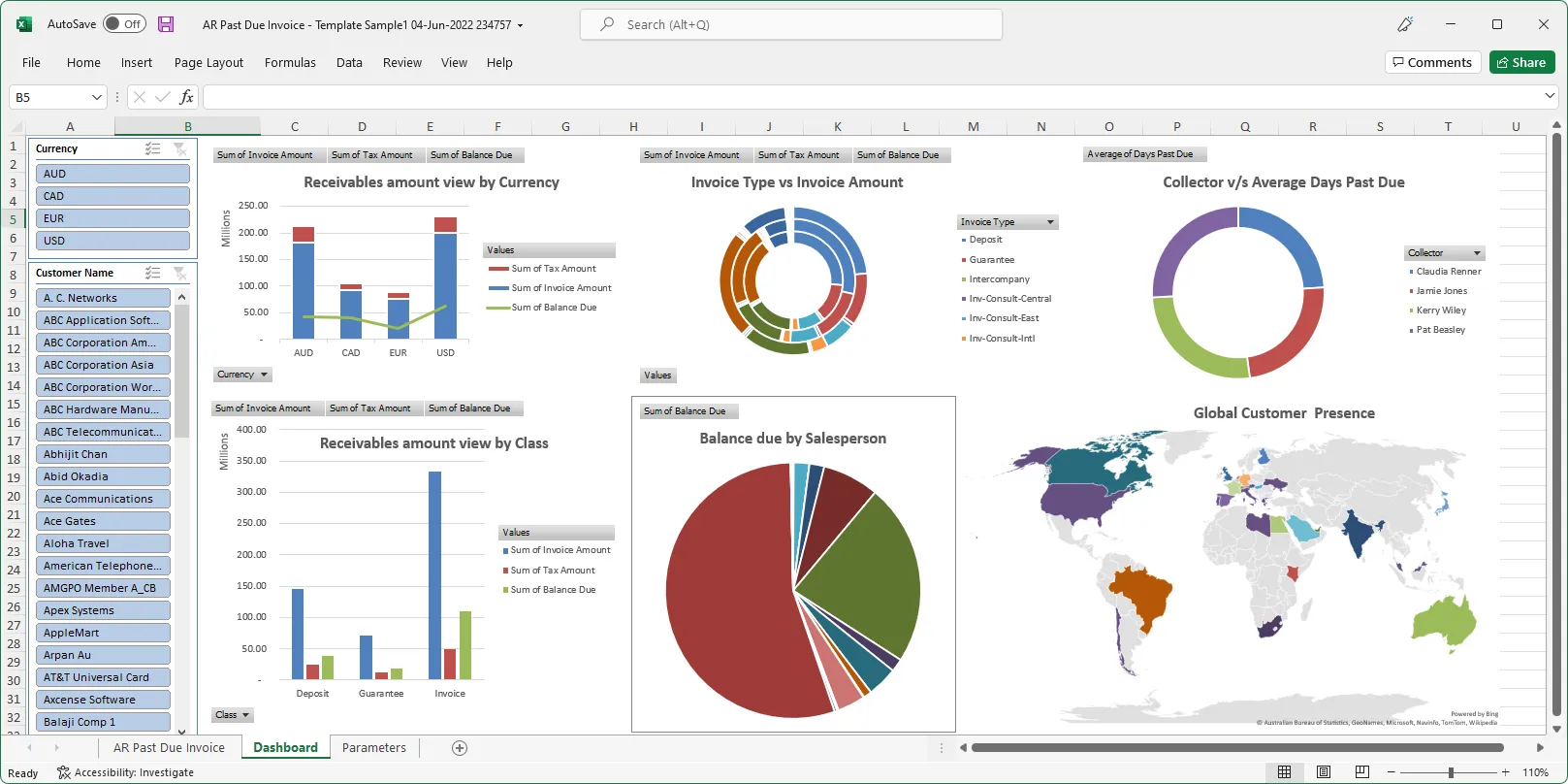
You can download and use Blitz Report free of charge for your first 30 reports.
The installation and implementation process usually takes less than 1 hour; you can refer to our installation and user guides for specific details.
If you would like to optimize your Oracle EBS implementation and or operational reporting you can visit www.enginatics.com to review great ideas and example usage in blog. Or why not try for yourself in our demo environment.
Blitz Report™ – World’s fastest data upload and reporting for Oracle EBS
Oracle Discoverer replacement – importing worksheets into Blitz Report™
Blitz Report™ Questions & Answers
Supply Chain Hub by Blitz Report™
© 2025 Enginatics